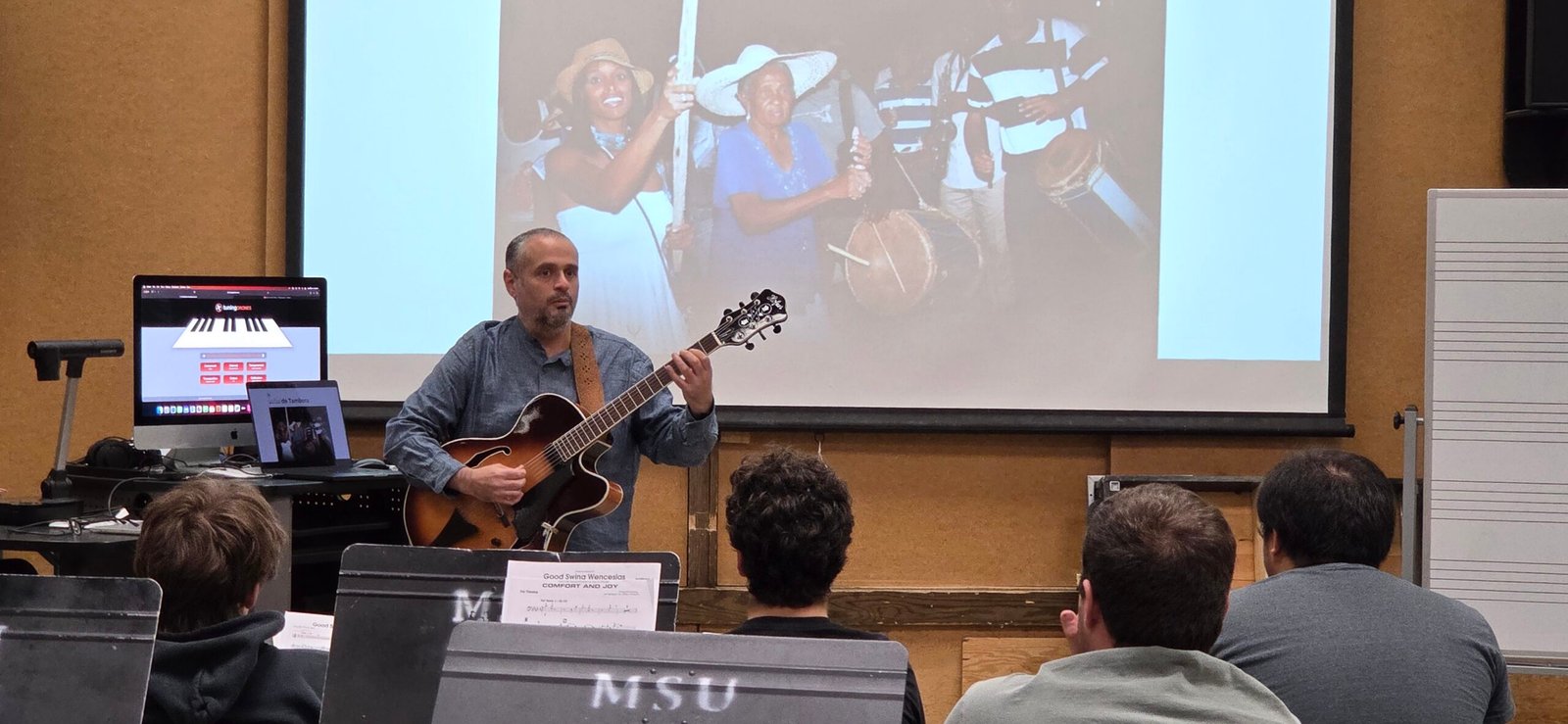







Tres Caminos
Traditional Rhythms as a Contemporary Creative Language
Available as a standalone activity or combined with a concert by the Pedro Barboza Trio.
Understand the creative process behind Tres Caminos and then experience it in performance.
Tres Caminos is an educational and performance program developed by guitarist, composer and educator Pedro Barboza around the music and creative processes of his album Tres Caminos.
The program explores how traditional Venezuelan rhythms can become active creative material for composition, improvisation and contemporary performance.
Through listening, cultural context, rhythmic analysis, notation and live demonstration, participants explore Venezuelan rhythmic traditions including Onda Nueva, Merengue Venezolano and Gaita de Tambora, among others, and examine how their musical principles can be transformed into new creative language.
The Experience
The program begins with the music itself.
Participants listen to selected traditional examples and explore the cultural and musical context behind each rhythm: its origins, characteristic patterns, accents, internal organization and approaches to notation.
Particular attention is given to the relationship between oral tradition and written music, and to the aspects of rhythmic character that cannot always be fully understood from notation alone.
From there, the focus moves from understanding to creation.
Using examples from Tres Caminos, Pedro Barboza demonstrates how rhythmic cells, accents and structural principles can move from their original context into new compositions, improvised lines and contemporary performance practices.
The objective is not simply to play over a traditional groove, but to understand enough of its internal language for it to become part of the musician’s own creative process.
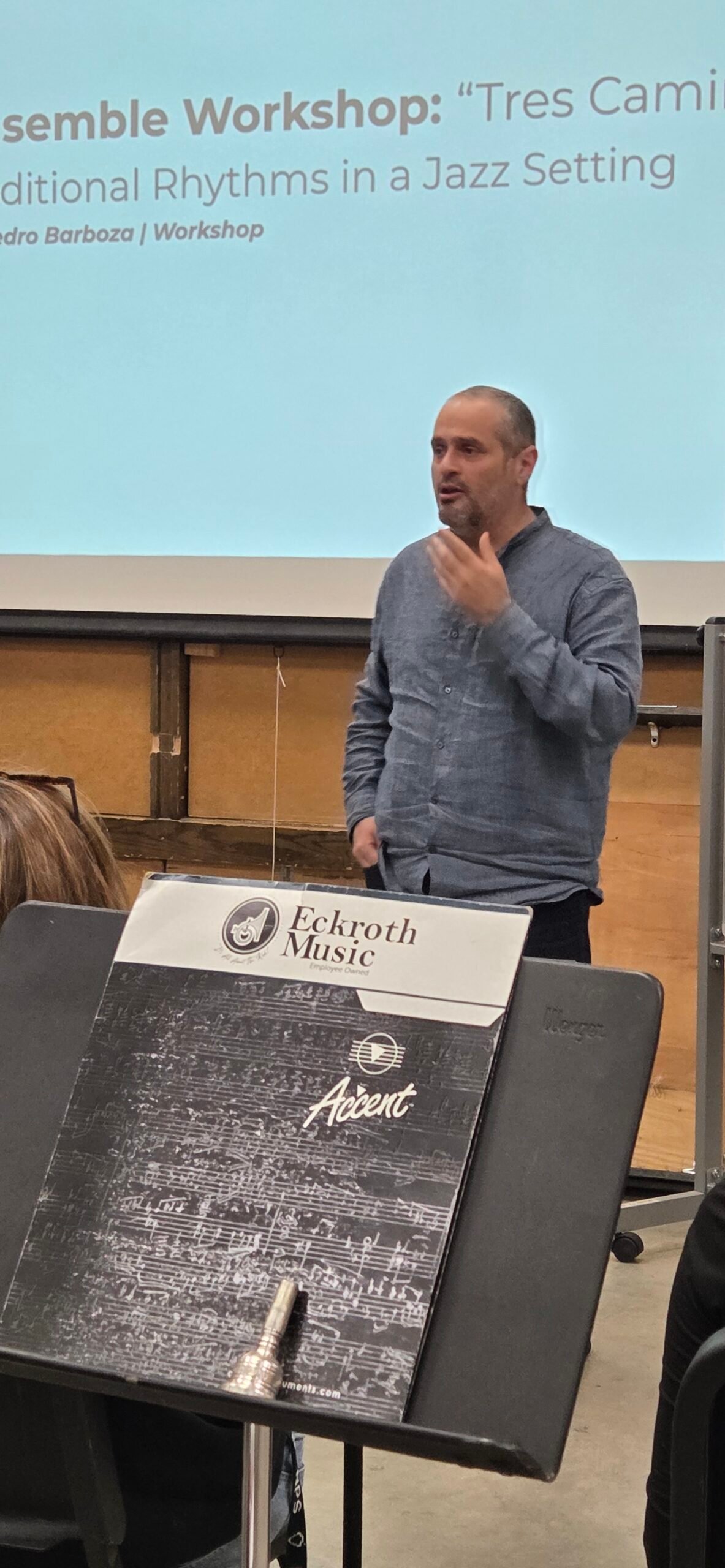
What participants will learn
Participants will develop practical ways to:
- Recognize characteristic rhythmic principles and accent patterns.
- Understand the relationship between traditional rhythmic language, notation and performance practice.
- Transform rhythmic cells into melodic, motivic and compositional material.
- Use rhythm as a source for phrasing and improvised ideas.
- Explore how traditional materials can be adapted without losing their connection to the source tradition.
- Apply selected concepts to their own composition, improvisation and performance practice.
Rhythm, Improvisation & Creative Language
One of the central threads of Tres Caminos is the relationship between rhythm and improvisation.
Rhythm is approached not only as accompaniment or groove, but as musical material capable of shaping:
phrasing · motifs · articulation · melodic development · interaction · improvised ideas
Participants explore how characteristic accents and rhythmic cells can influence the construction of a phrase and become part of an improviser’s vocabulary.
The same principle is applied to composition: rhythmic elements drawn from traditional music can become structural material for creating new works.
In this way, the program creates a direct connection between:
listening → understanding → transformation → creation
Selected Musical Materials
The program can draw on different Venezuelan rhythmic traditions according to the format, duration and interests of the institution. Examples include:
Onda Nueva
A Venezuelan musical language developed by Aldemaro Romero, connecting traditional rhythmic elements with jazz-influenced harmony and arrangement.
Merengue Venezolano
A rhythm with a distinctive asymmetric identity, traditionally transmitted orally and represented through different approaches to notation.
Gaita de Tambora
An Afro-Venezuelan tradition from the south of Lake Maracaibo, explored as a source of rhythmic character, phrasing and compositional material.
These examples are not presented as a closed repertoire. Other rhythmic traditions can be incorporated according to the focus of the session.
Formats
Masterclass / Lecture-Demonstration
A focused session combining listening, cultural context, musical analysis and live demonstration.
Typical duration: 60–90 minutes
Suitable for larger groups and lecture-style settings.
Workshop / Creative Lab
A more participatory format in which students can experiment directly with selected rhythmic, compositional and improvisational concepts.
Typical duration: 2 hours
Participation can involve individual musicians or small groups and does not require a predetermined ensemble or instrumentation.
Extended Workshop / Intensive
A longer format allowing deeper work on rhythmic materials, composition, improvisation and student participation.
Typical duration: up to 3 hours
Education + Concert
The masterclass or workshop can be combined with a live performance by the Pedro Barboza Trio.
This format connects the educational content directly with the music of Tres Caminos.
Education + Live Performance
Explore the music. Understand the process. Experience it live.
When presented with the Pedro Barboza Trio, Tres Caminos creates a direct bridge between education and performance.
The educational session introduces the musical and cultural materials behind the project.
The concert then allows students and audiences to hear those same ideas functioning in real time through composition, improvisation, interaction and ensemble performance.
This format is especially suited to:
Universities · Conservatories · Music Schools · Jazz Programs · Festivals · Cultural Institutions
It can also form part of educational or audience-engagement programs connected to a festival or concert series.
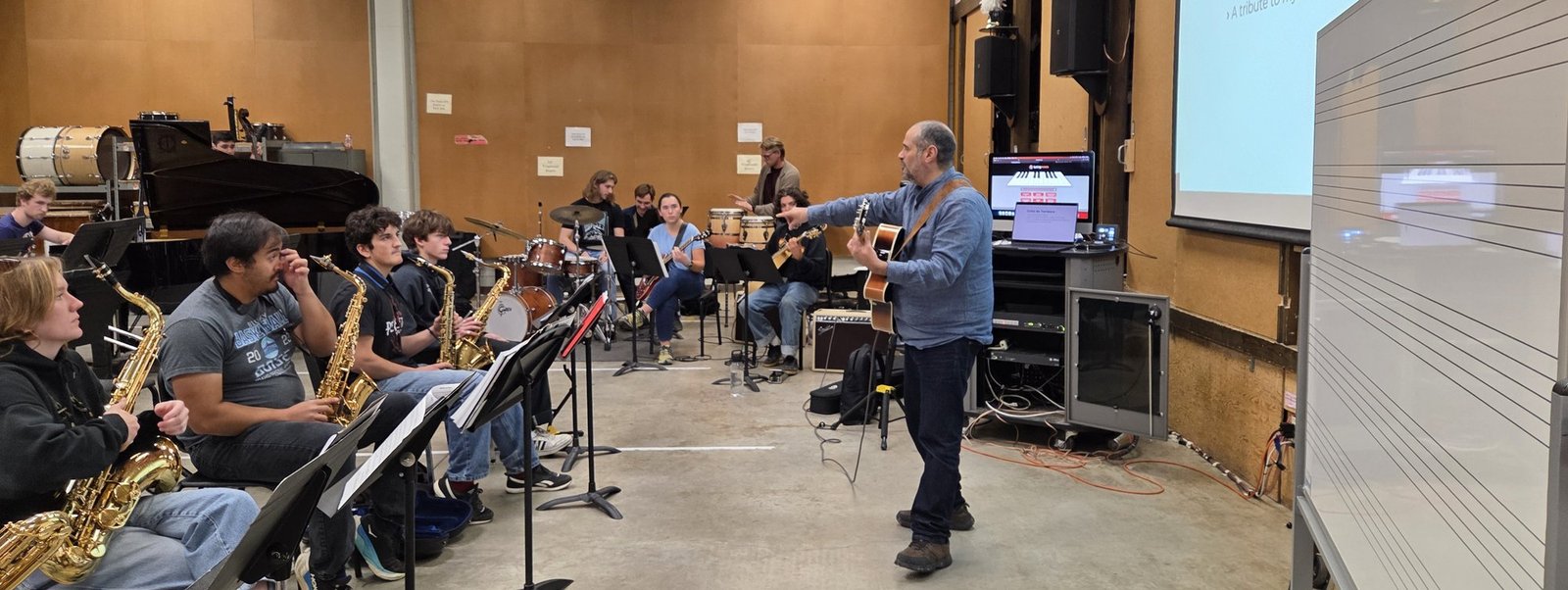
Selected Presentations of Tres Caminos
Berklee College of Music · Boston · 2025
Tres Caminos was presented through a program combining a workshop with students and a live concert presentation, connecting Venezuelan rhythmic traditions with composition, improvisation and contemporary performance.
Montana State University · Bozeman · 2025
Pedro Barboza presented Tres Caminos in an educational setting, exploring the Venezuelan rhythmic traditions behind the project, their cultural context and their transformation into contemporary composition and improvisation.
Who is it for?
The program can be adapted for students and musicians working in:
Jazz · Improvisation · Composition · Contemporary Music · Guitar · Performance · Rhythm · Latin American Music
It can also be adapted for broader cultural audiences when presented as a lecture-demonstration or as part of a festival or cultural institution program.
The activity can be delivered in English or Spanish.
About Pedro Barboza
Pedro Barboza is a Venezuelan guitarist, composer and educator based in Madrid.
His artistic work connects contemporary jazz, improvisation and Venezuelan musical traditions, while his educational practice spans more than three decades of teaching, masterclasses, workshops and Visiting Artist programs in Europe, the United States and Latin America.
A Berklee College of Music alumnus and founder of Escuela Itinerante de Música, his work as an educator focuses on transforming musical knowledge into practical tools for improvisation, composition and the development of an individual creative language.
His educational work also extends into entrepreneurship and innovation in music learning.
Visiting Artist Option
Tres Caminos can be presented as an individual masterclass or workshop, or incorporated into a broader Visiting Artist Program.
Programs can be developed for one or several days according to the academic and artistic interests of the host institution.
A Visiting Artist residency can combine:
Masterclasses · Workshops · Creative Labs · Student Sessions · Artist Talks · Concerts
Bring Tres Caminos to your institution
Tres Caminos can be presented as:
a masterclass
a workshop or creative lab
an educational activity connected to a festival or cultural program
a workshop + Pedro Barboza Trio concert
part of a multi-day Visiting Artist residency
Each program can be adapted to the audience, duration and academic or artistic context of the institution.
Bookings open for the 2026–27 season and beyond.
Write to me directly
Tell me what you have in mind and I will reply with a proposal adapted to your institution.